

Peer-to-peer payment apps have become a standard part of everyday money movement, but the experience is far from seamless. According to a survey by American Banker’s Market Intelligence team, consumers are frustrated by a fragmented landscape in which apps do not communicate with one another, instant transfers carry fees, and funds are not always available when people need them.
The survey of 1,000 U.S. consumers, conducted in May and June, examined payment habits and engagement with nontraditional payment products, including digital P2P apps from well-known nonbanks and on-chain technologies such as cryptocurrencies and stablecoins used as payment mechanisms.
Interoperability Is the Leading Desire
Most digital wallet and payment apps operate as closed-loop networks. Users must maintain accounts and store deposits across multiple platforms because funds generally cannot move from one app to another. PayPal and Venmo are an exception, as Venmo is a subsidiary of PayPal, but that interoperability only arrived last year.
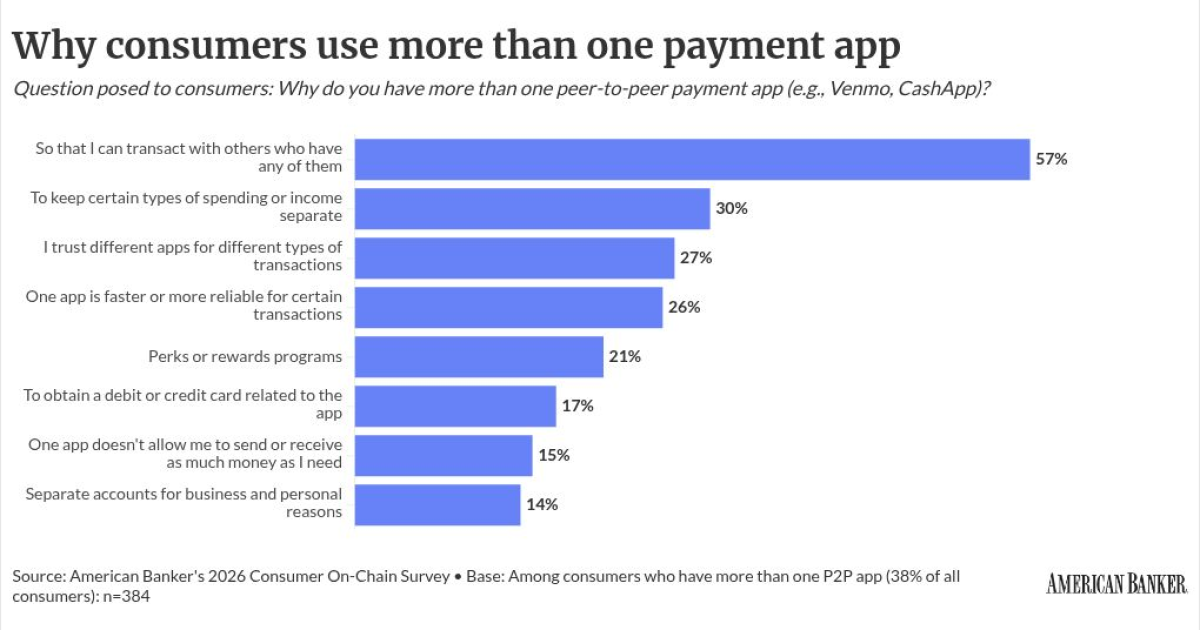
This structural isolation forces consumers to juggle multiple accounts to interact with different people in their networks. The survey found that 65% of P2P app owners hold more than one P2P app, and 57% of multi-app owners cite reach as the reason. About 24% of P2P users say the problem of a recipient or sender not being on the same app affects them always or often.
Multi-app usage is inversely related to age. Among Gen Z, 75% hold two or more P2P apps, and 43% maintain three or more, with 30% using three apps and 13% using four or more. Millennials are close behind at 72% holding two or more. Single-app usage increases with age, peaking among Boomers, where 62% rely on only one provider and just 13% hold three or more. Gen X falls in the middle, with 73% using either one app (34%) or two apps (39%).
When asked to agree or disagree with nine statements about their financial lives, consumers placed cross-platform payments above every concern except money-management confidence. Seventy-five percent agreed they wish different payment apps could work together. Worrying about fraud followed closely at 73%, far ahead of the view that their bank’s technology is outdated at 24%.
Demand for interoperability is strongest among younger consumers: 87% of Gen Z, 86% of Millennials, and 81% of Gen X want payment apps to work together. Consumers who send cross-border payments often or occasionally show high demand as well, at 86% and 85%, respectively. Even among consumers who never send cross-border payments, 72% still want app interoperability. Because this group represents a much larger total sample size, their share reflects a significant number of users and shows that fragmentation is a pain point across all digital payment users, domestic or international.
PayPal continues to lead consumer preference in the P2P market with a 35% share, while Cash App follows at 28%. PayPal’s position stems largely from its first-mover advantage and widely held consumer trust. Originally founded as a web-first checkout solution for online merchants and shoppers, the platform has expanded over two decades into a multi-faceted financial ecosystem with digital balances, high-yield savings options, cross-border payments, and secure checkout across millions of global retailers.
Fees and Speed Drive Frustration
App fragmentation is only part of the problem. When examining the specific pain points across all transaction types, financial cost consistently tops the list. Instant-transfer fees are the leading P2P problem, with 35% of users encountering them always or often. High transaction fees lead cross-border problems at 38%, and unexpected transaction fees top the reasons consumers abandoned a purchase or payment in the past year at 18%, tied with intrusive data requests at 18%.
Cost friction is directly correlated with the speed of payments. Many P2P payments feel instantaneous from the user’s perspective but are not actually settled immediately. For example, Venmo updates the ledger on the user side, but true settlement can take a few days because Venmo often uses ACH. To get funds instantly through Venmo, users must choose the instant payment option, which carries an additional fee. The real-time payment method costs more per payment to use the RTP rail, and Venmo must manage higher fraud risks and front the liquidity to make funds available in minutes.
This trade-off between speed and cost reflects a broader urgency around immediate fund availability in consumers’ day-to-day financial lives. Only 26% of workers are totally satisfied with how they are paid now. When asked what they would change about how they get paid, the top three wishes relate to having money when they need it: 36% want to be paid more frequently, 30% want instant access to wages as they earn them, and 30% want to choose their own pay schedule. Better integration between pay and financial apps or accounts finishes last of the seven changes offered, at 14%.
Asked which pay methods are unavailable to them but wanted, employees name cash most often at 16%, followed by an early wage access app such as DailyPay or Even at 14%.
What the Findings Mean for Banks and Payment Providers
With more P2P payment options than ever before, the average consumer operates in a complex and fragmented ecosystem. Stablecoins and cryptocurrencies also lack interoperability, operating on different blockchains and by different issuers. Whether juggling platforms to split a bill or paying a fee to access earned wages early, users are actively seeking seamless, cost-effective liquidity.
Banks already hold the infrastructure, regulatory trust, and capital to enhance the payment frequency and interoperability consumers want. Solving the speed-versus-cost conundrum will define the next generation of digital payment leaders.
Methodology
The On-Chain Consumer Survey 2026 was fielded by American Banker’s Market Intelligence team among 1,000 U.S. consumers in May-June 2026. The sample is balanced cellwise to the U.S. census by gender and age, and to the overall white non-Hispanic share. Composition within the non-white/Hispanic group was not quota-controlled and departs from census: Black respondents are over-represented and Hispanic respondents under-represented. Figures are unweighted. Race, ethnicity, and region results describe this sample and should not be read as national estimates.
Conditional bases used throughout: employed respondents n=600; uses a P2P app n=844; owns at least one P2P app n=582; sends money internationally n=275; holds cryptocurrency n=263; has a primary checking account n=778.