

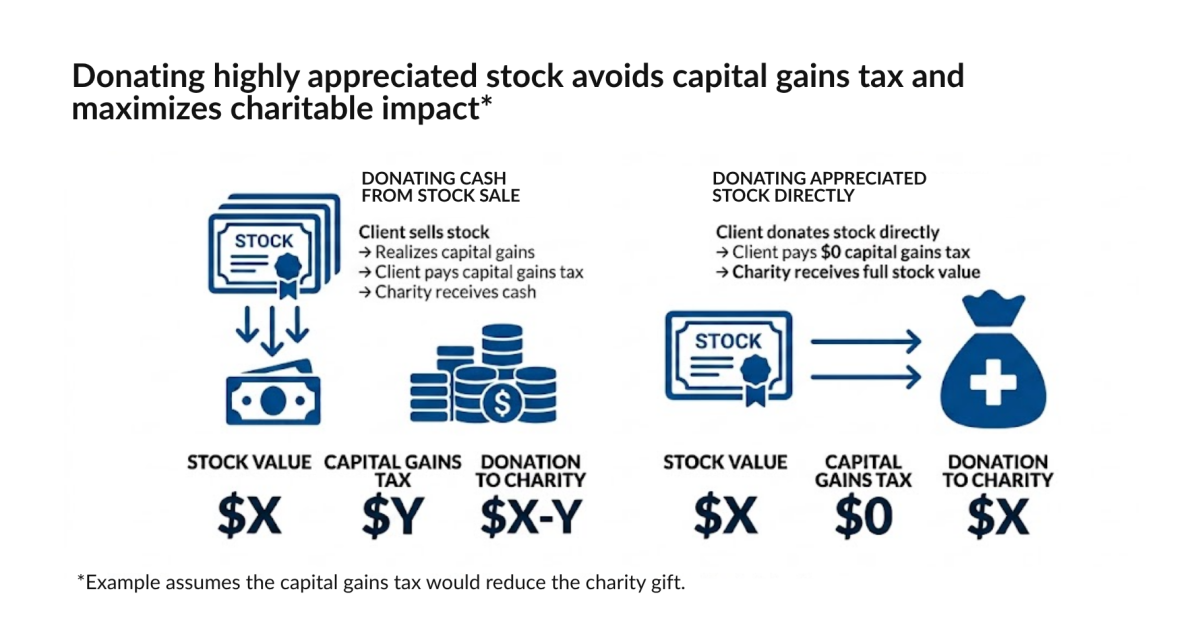
Donating highly appreciated stock to charity can be a smart financial move for investors looking to reduce their tax burden. Instead of selling the stock and paying capital gains tax, you can transfer the asset directly to a qualified charity. This strategy not only avoids the tax hit but also provides a charitable deduction based on the stock’s fair market value at the time of the gift.
Why Donate Appreciated Stock?

When you sell appreciated stock, you owe capital gains tax on the increase in value. By donating the stock directly to a charity, you bypass the sale and the associated tax. The charity receives the full value of the asset, and you can claim a deduction for that value, subject to IRS limits.
New Tax Deduction for Non-Itemizers
A federal law enacted in July 2025 introduced a special deduction for cash donations to qualified charities, even for taxpayers who do not itemize. This deduction is $1,000 for single filers and $2,000 for married couples filing jointly. While this applies to cash gifts, donating appreciated stock generally requires itemizing to claim the deduction, so it’s important to evaluate your overall tax situation.
How to Donate Stock to Charity

The process is straightforward for publicly traded securities. You can transfer the stock directly to the charity, or use a donor-advised fund or private foundation. This approach avoids the need for a formal appraisal, which is often required for other types of in-kind donations.
According to Wesley Karger, co-founder and managing partner at TwinFocus, a Boston-based RIA, “We’re looking for liquid assets that are highly appreciated, where you preserve the tax benefit.” He notes that donating stock is simpler than giving physical assets like cars, boats, or art, which require complex appraisals and may face more scrutiny from the IRS.
Considerations for Other In-Kind Donations
While donating stock is often the most tax-efficient strategy, some clients may wish to give other assets. However, these gifts come with additional challenges.
Appraisal Requirements
For non-stock assets, a qualified appraisal is essential. As Benjamin Sunshine, senior associate at Brinkley Morgan, explains, “If you are giving gifts that are not stock, it’s important to get a qualified appraisal as part of the gift because, if you don’t, then you’ll lose your deduction. So there’s a lot of traps.”
Even for cryptocurrency, which is traded on exchanges, the IRS requires a qualified appraisal for donations over $5,000. Sunshine adds, “It’s very easy to get a qualified appraisal for cryptocurrency because it is traded.”
Charity’s Use of the Asset Matters
The deduction amount can depend on how the charity uses the donated asset. Colleen Spain, counsel at Farrell Fritz, points out that if a charity plans to sell a donated car immediately, the donor’s deduction is limited to the gross proceeds from that sale. However, if the charity uses the vehicle for a “significant intervening use”—such as a delivery van for a soup kitchen—the deduction may be based on the vehicle’s fair market value.
Spain also notes that “organizations are better able to use and accept appreciated stock,” making it a preferred gift for many charities.
Practical Tips for Donors
- Consult with your financial advisor and tax professional before making a gift.
- For stock donations, ensure the transfer is completed directly to the charity or through a donor-advised fund.
- For non-stock assets, obtain a qualified appraisal and document the charity’s intended use.
- Be aware of IRS rules regarding the type of asset and the charity’s use to maximize your deduction.
Donating appreciated stock is a powerful way to support charitable causes while minimizing your tax liability. By understanding the rules and seeking professional guidance, you can avoid common pitfalls and make the most of your philanthropic efforts.