

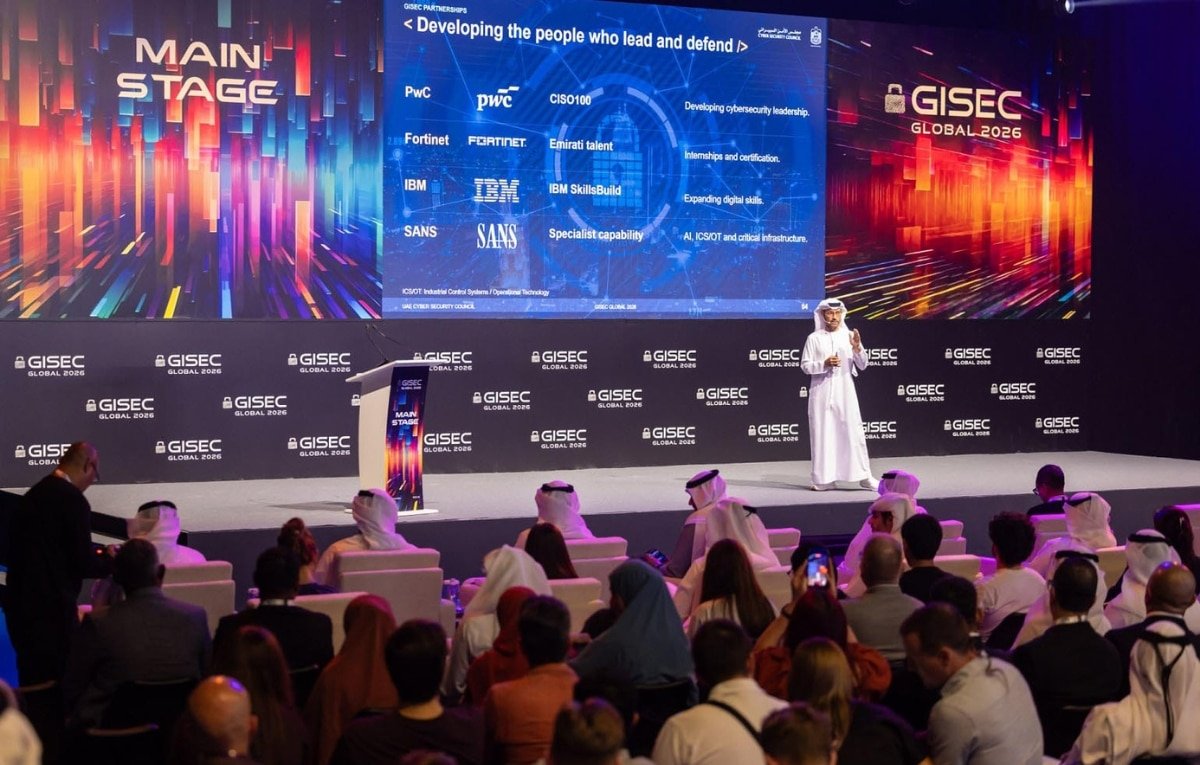
The first day of GISEC Global 2026 in Dubai placed artificial intelligence, national resilience, and critical infrastructure protection at the center of discussions. International experts and officials examined how emerging technologies and geopolitical shifts are reshaping the cybersecurity landscape both regionally and globally.
Sessions focused on the rise of AI-powered cyber threats, ways to protect digital economies, and the need to strengthen international cooperation against risks targeting vital systems.
AI Reshapes Cyber Threats

Key sessions addressed the impact of artificial intelligence on both cyber defense and cybercrime, with particular attention to risks facing critical infrastructure.
During a session titled “Cybersecurity Draws the Features of the New World Order,” Dr. Mohamed Al Kuwaiti, Head of the UAE Cybersecurity Council, reviewed the strategic implications of AI-powered cyber threats. He emphasized the link between cyber resilience and national and economic security, and the importance of collective defense against attacks.
“Cybersecurity culture is everyone’s responsibility. Our society remains our first line of defense,” Al Kuwaiti said.
In a keynote titled “The Decade of Deepfakes: What Hollywood Learned First,” actor Michael Kelly discussed the risks of deepfake technologies as the ability to imitate people’s voices and images grows, raising challenges related to identity, consent, and digital trust.
Kelly stressed the importance of identity verification and content authentication, and ensuring individuals control the use of their images and voices. “Your voice and your image are your identity. No one should be able to use them without your knowledge and consent,” he said.
Protecting AI Systems and Strengthening Resilience
Discussions extended to the exhibition floor, where companies showcased solutions to enhance cyber resilience amid growing AI-powered threats.
Ayman Hamouda, Senior Director of Sales Engineering at Cohesity, said AI agents help boost productivity, automate decisions, and run core operations, but they can also disrupt operations, undermine data reliability, and amplify errors.
He explained that AI protection is no longer limited to securing models; it now includes agents, memory, data, and the systems they rely on, while ensuring they can be recovered in the event of disasters.
Hamouda stressed the need to build resilience from the start to protect AI systems and their data and ensure business continuity.
Critical Infrastructure: Safety First
First-day sessions examined operational risks facing vital sectors, including oil and gas, with a focus on threats targeting digital twins and operational technology systems.
A session titled “Operational Resilience in the Oil and Gas Sector” discussed the implications of breaching operational environments, while “Cyber Resilience in Critical Infrastructure” addressed ways to enhance the protection of vital facilities and services.
Participants noted that traditional protection models based on securing network perimeters are no longer sufficient given the growing interconnection between digital systems and physical operations. They warned that tampering with sensor inputs or digital models could lead to misleading results in digital twins, affecting the safety and continuity of operations.
Khaled Al Tunaiji, Chief Cybersecurity Officer at ENOC Group, emphasized the need to assess attacks based on their impact on business, operations, cyber-physical systems, and safety, rather than separating information technology and operational technology security.
Al Tunaiji stressed that safety is the priority in protecting critical infrastructure, noting the importance of non-cyber controls such as mechanical protection measures and the ability to switch to manual or limited operation to ensure essential services continue.
He cited the Colonial Pipeline incident to illustrate how an attack that begins in IT systems can extend its impact to physical operations and vital services.
Digital Sovereignty and International Cooperation
Discussions highlighted the growing relationship between cybersecurity, national security, and digital sovereignty, examining how decisions related to digital technologies affect global power balances.
The UAE Cybersecurity Council hosted the Digital Security Conference to enhance regional and international cooperation, while the Government Platform, hosted by the Dubai Electronic Security Center, discussed ways to secure digital economies and build sovereign capabilities.
In a session titled “Building the World’s Safest City in the Era of AI-Powered Threats,” Amer Sharaf reviewed Dubai’s efforts to enhance resilience and digital security.
Sharaf noted that AI is accelerating the evolution of attacks and cyber defense methods, alongside growing risks of deepfakes and identity impersonation. He stressed the importance of integrating cybersecurity into digital infrastructure design from the outset, and strengthening AI-supported defense and trusted digital identity to support resilience and public trust.
“Safety is not limited to the physical world; it also includes the digital world. Make cybersecurity a shared responsibility,” Sharaf said.
Live Demonstrations and Interactive Training
The Dark Stage platform featured live demonstrations by ethical hacking and open-source intelligence experts, allowing attendees to learn practically about attack techniques and modern investigation methods.
Attendees also participated in interactive training and challenges, including the Dubai Cyber Challenge and GISEC Decode, while the Global Quantum Training and Cyber Defense School initiatives continue throughout the event.
Global Leaders Discuss AI Sovereignty
A global leadership roundtable titled “The Imperative of AI Sovereignty: Protecting the $28 Trillion Digital Economy” brought together officials and experts from cybersecurity, technology, and finance.
Participants included Dr. Mohamed Al Kuwaiti; Supra Kumaraswamy, Senior Vice President and Chief Information Security Officer at Visa; Christophe Blassiau, Senior Vice President and Global Chief Information Security Officer and Cyber Physical Security at Schneider Electric; Alex Atoumali, Global Chief Information Security Officer at Under Armour; and cybersecurity researcher and former hacker Solomon Gilbert.
They discussed ways to enhance cyber resilience, protect digital sovereignty, and secure the technologies that support the global digital economy.
GISEC 2026 Continues Until September 18
GISEC Global 2026 continues until September 18 at the Dubai World Trade Centre under the theme “Cyber First: The New Digital Order.”
Upcoming sessions will address AI security, ransomware, critical infrastructure protection, cloud security, cyber warfare, digital forensics, device security, and 5G and emerging technologies.
According to the organizers, this year’s edition brings together more than 25,000 participants, 750 exhibiting brands, and over 350 speakers from more than 180 countries, following the success of the 2025 edition.
For more information, visit the official website: gisec.ae.