

As chairman and CEO of a Detroit-based community bank and current chair of the American Bankers Association (ABA), I have spent years listening to bankers across the country. I have seen how deposits fuel local lending—helping families buy homes, entrepreneurs open businesses, and communities grow. That is why I take issue with recent claims that community bankers are being used as a “stalking horse” in the CLARITY Act debate. Such suggestions misunderstand the independence and integrity of community bankers.
The Real Threat: Stablecoin Yield and Deposit Migration
At the heart of the CLARITY Act discussion is a critical issue: the potential for stablecoins to offer interest-like rewards that pull money away from traditional bank deposits. If consumers and businesses shift funds from bank accounts to stablecoins that mimic interest payments, those funds would no longer support local lending. Instead, much of the backing reserves would be invested in Treasury securities and other assets, not in small-business loans, mortgages, or agricultural credit.
At scale, this migration could put billions of dollars of lending capacity at risk. Smaller and rural communities would likely feel the impact first, as they rely heavily on community banks for credit.
Community Bankers Are Independent Voices
As ABA chair, I have traveled extensively and urged bankers of all sizes to examine the stablecoin provisions carefully and voice their concerns to lawmakers. Their engagement is not orchestrated by large financial institutions. It reflects the independent judgment of bankers who understand how deposits support lending in their own neighborhoods.
Community bankers are not opposed to digital assets. My own bank serves fintech and crypto customers, giving us practical insight into responsible innovation. We recognize that blockchain technology and digital assets will play a role in the future of finance. The question is whether that future will be built on a balanced regulatory foundation or on incentives that unintentionally drain funding from local lenders.
Congress Should Close the Yield Loophole
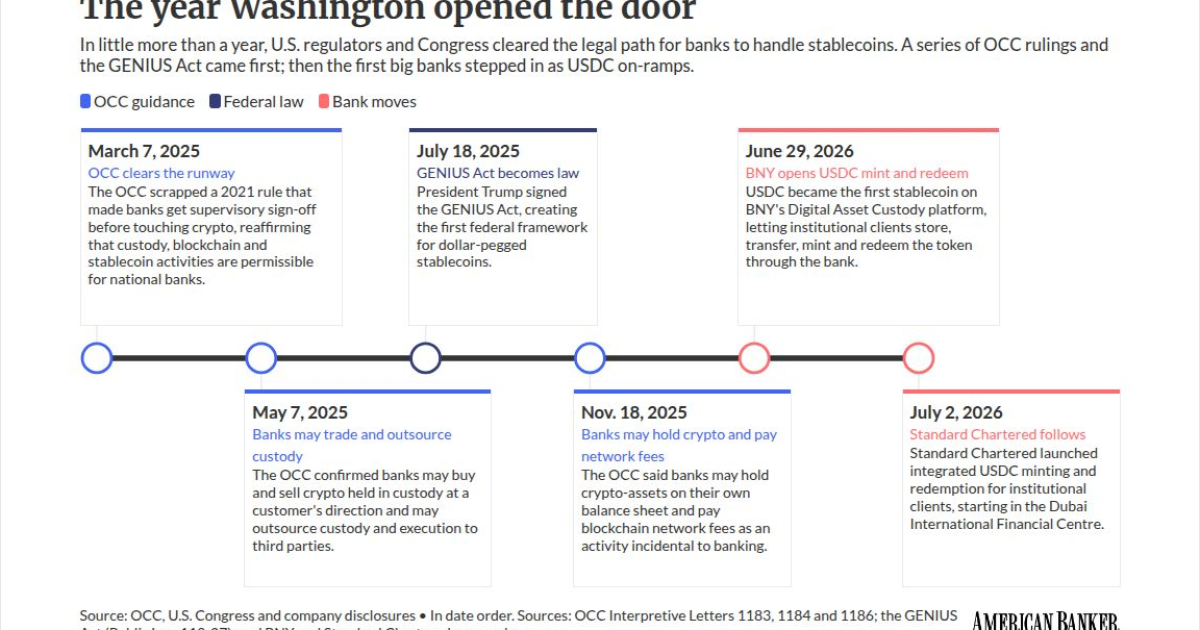
The GENIUS Act already prohibits payment stablecoin issuers from paying interest to holders, recognizing that payment stablecoins should function as payment instruments, not deposit substitutes. However, some crypto companies have circumvented this by offering yield-like rewards that effectively mimic interest.
The CLARITY Act offers the Senate a chance to close that gap with narrowly tailored language. Doing so would not stifle innovation. It would reinforce the distinction Congress has already made, improve the bill’s chances of passage, and give the crypto industry the clear rules it has long sought.
Banks Are Already Innovating
Contrary to claims that community bankers fail to see the potential of digital assets, the banking industry is actively exploring tokenized deposits, blockchain-based payments, stablecoins, and digital custody. Many banks, including my own, have digital asset committees and fintech partnerships. The U.S. can remain the world’s banking capital while also becoming the crypto capital—provided the right rules are in place.
Innovation within a sound regulatory framework can expand access, lower costs, and speed payments. But innovation should not rely on regulatory arbitrage or on offering the economic equivalent of a bank deposit without the corresponding obligations for consumer protection, capital, liquidity, and community responsibility.
A Shared Responsibility
Community banks, regional institutions, and large banks may differ in size and strategy, but we share a fundamental duty: converting deposits into credit that supports households, businesses, and local economies. We also share an interest in building a digital financial system that serves the entire country—not just a few companies seeking a legislative advantage.
Community banks are no one’s stalking horse. We understand the technology, the economics, and the stakes. We have been transparent about our position and are speaking for ourselves in support of responsible innovation, durable rules, and a financial system that continues to serve communities across America. The Senate should listen.