

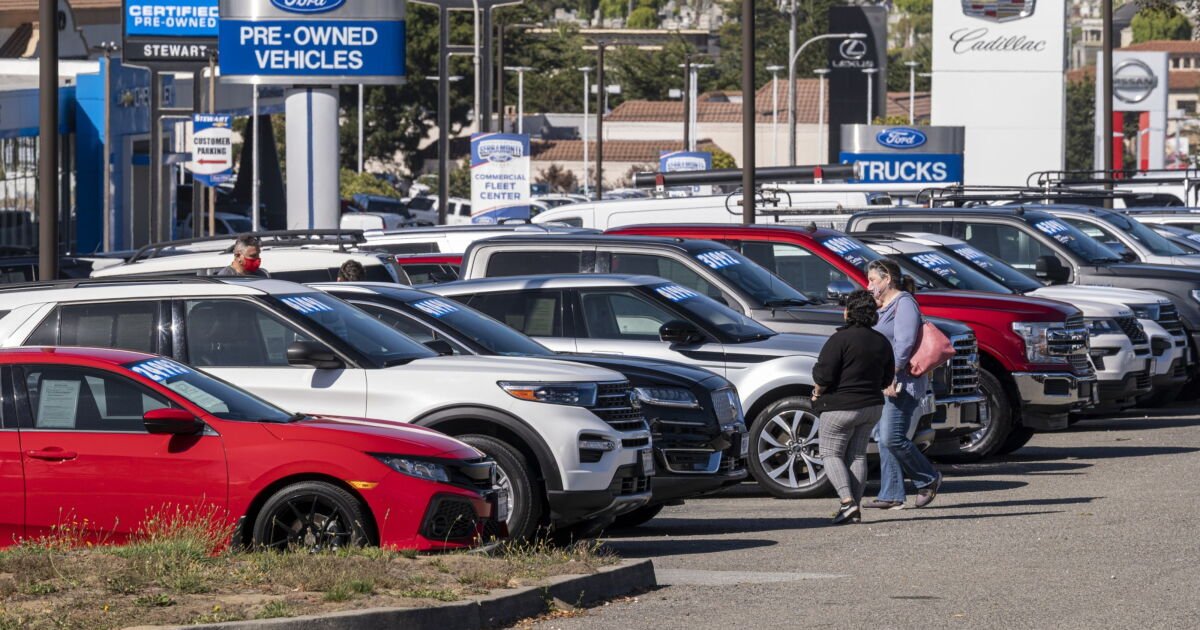
Walmart’s push into financial services is accelerating as its majority-owned fintech, OnePay, expands into auto finance and payment tools. The company recently launched My Garage, a feature designed to centralize vehicle-related financial information and transactions in one place.
What My Garage Offers
Consumers using OnePay’s app can now access their vehicle’s current estimated value, outstanding loan balance, payoff timeline, auto insurance quotes, and gas rewards—all within a single dashboard. The goal is to replace the fragmented experience of checking multiple apps or websites for car-related financial data.
Pat McLoughlin, general manager of Marketplace at OnePay, explained the rationale in an email: “Your car is one of the biggest expenses in your life, but most people have no idea what it’s worth, what they still owe, or whether they’re overpaying for insurance.” He added that consumers don’t think in terms of financial products but rather what those products enable in their daily lives. “[We’re giving] people financial visibility into one of the most expensive assets they own but rarely fully understand,” McLoughlin said.
Why Auto Finance Attracts Fintechs and Banks
Auto finance is a major purchase—typically the second largest after housing—and remains highly fragmented, drawing both fintechs and traditional banks seeking to simplify the user experience. Several institutions are already innovating in this space:
- Origence and Catalyst Corporate Federal Credit Union recently launched instant payments via FedNow in partnership with Tesla, allowing credit unions using Origence’s FI Connect lending platform to fund auto loans to the automaker in real time.
- TD Auto Finance, the U.S. arm of Toronto-Dominion Bank, has integrated support for the bank-led RTP network to speed up payments.
- U.S. Bank collaborated with Driveway.com, Lithia Motors’ e-commerce unit, to link new payment technology with auto-related financial services.
OnePay aims to stand out by consolidating scattered car-related expenses—loans, insurance, gas, maintenance—alongside other financial products. “Most consumers don’t want a bunch of different apps for their money,” McLoughlin noted.
OnePay’s Broader Financial Ecosystem
OnePay was formed in 2022 through the merger of several fintech startups, including Hazel and challenger bank One. Its product suite includes debit cards issued by Green Dot and high-yield savings accounts provided by Coastal Community Bank. The company also partners with Synchrony Financial to offer a co-branded credit card usable anywhere and a private-label card for Walmart purchases, both embedded in the OnePay app.
Additional offerings include buy-now-pay-later services via Klarna at Walmart stores, credit access through a partnership with Upstart, and OnePay Wireless—a prepaid phone plan launched in September 2025, powered by Gigs and running on the AT&T network.
Competitive Landscape and Expert Views
OnePay’s move into auto finance faces competition from neobanks like Chime, traditional banks, and financial aggregators such as CreditKarma. Aaron Press, research director of Worldwide Payment Strategies, sees this as an open banking and data access play. “OnePay is gathering data from a few different places, presumably using an open banking framework to provide a single, complete picture of the financial impact of a vehicle,” he said. “This is something many banks will enable, but perhaps not as a discreet product or with as complete a picture.”
Aaron McPherson, principal at AFM Consulting, likens My Garage to a personal finance application with embedded lending. He suggests that PayPal could pursue a similar strategy to strengthen its consumer value proposition. “To the extent that other financial institutions have an auto lending program, it would be relatively easy to add vehicle tracking functionality. That is where I would look for bank responses to OnePay,” McPherson said.