

Colorado’s top law enforcement official has filed a lawsuit against EarnIn, a direct-to-consumer earned wage access (EWA) provider, alleging the company violated state lending laws. The case reignites a key regulatory question: should EWA products be treated as loans?
The Allegations
Attorney General Phil Weiser claims EarnIn’s Cash Out product functions as a high-interest loan, despite the company’s assertion that it is nonrecourse. The lawsuit argues that EarnIn’s repayment methods resemble those of payday lenders and that the company used deceptive design tactics to extract fees.
“Colorado voters acted decisively in 2018 to rein in predatory payday lending. EarnIn’s product, however, provides consumer loans at high interest rates that are styled as accessing their pay,” Weiser said in a statement. He added that EarnIn “acted as a third-party lender and charged illegally high rates, used deceptive design strategies to extract some charges, and trapped consumers in repeat borrowing.”
The complaint specifically challenges EarnIn’s disclaimer of any legal repayment obligation, stating that “under [previous precedent], EarnIn’s Cash Outs are loans under Colorado law, and EarnIn’s contention that its product is not a loan based on its disclaimer of any legal repayment obligation lacks any real-world significance given how the Cash Out transactions actually operate in practice.”
EarnIn’s Response
EarnIn’s General Counsel, David Durant, defended the product in an email to American Banker. “This lawsuit doesn’t protect Colorado consumers — it seeks to take away a financial tool that nearly 200,000 Coloradans have relied on, while protecting the overdraft fees and late payment penalties Coloradans turn to when they can’t wait for payday,” he wrote.
Durant emphasized that Cash Out is not a loan, as customers access already-earned wages with no obligation to repay, no interest, and no mandatory fees. He cited independent research claiming the product increases users’ income by 11.5% per month. He also expressed disappointment that after over a year of engagement, the Attorney General’s office chose litigation over a legislative solution, noting EarnIn’s support for state legislation that would license EWA providers and cap charges.
Regulatory Context
The EWA industry has largely succeeded in securing exemptions from usury laws in states with specific EWA legislation. However, this lawsuit reflects growing scrutiny from regulators who question whether direct-to-consumer models should be exempt.
Benjamin Nestor, a strategic advisor at Datos, explained to American Banker that if a D2C advance is classified as a loan, it would be subject to state usury caps (present in at least 44 states) and federal lending statutes like the Truth in Lending Act and the Equal Credit Opportunity Act.
Nestor noted that D2C providers face greater regulatory risk than employer-integrated (B2B) models because they lack employer verification of hours worked and payroll deduction repayment mechanisms. “That’s functionally closer to how a lender collects on a loan, which is precisely the comparison regulators have started drawing and show skepticism toward – in addition to additional fees or ‘tips’ that (as a percentage) can be quite high,” he said.
Broader Implications
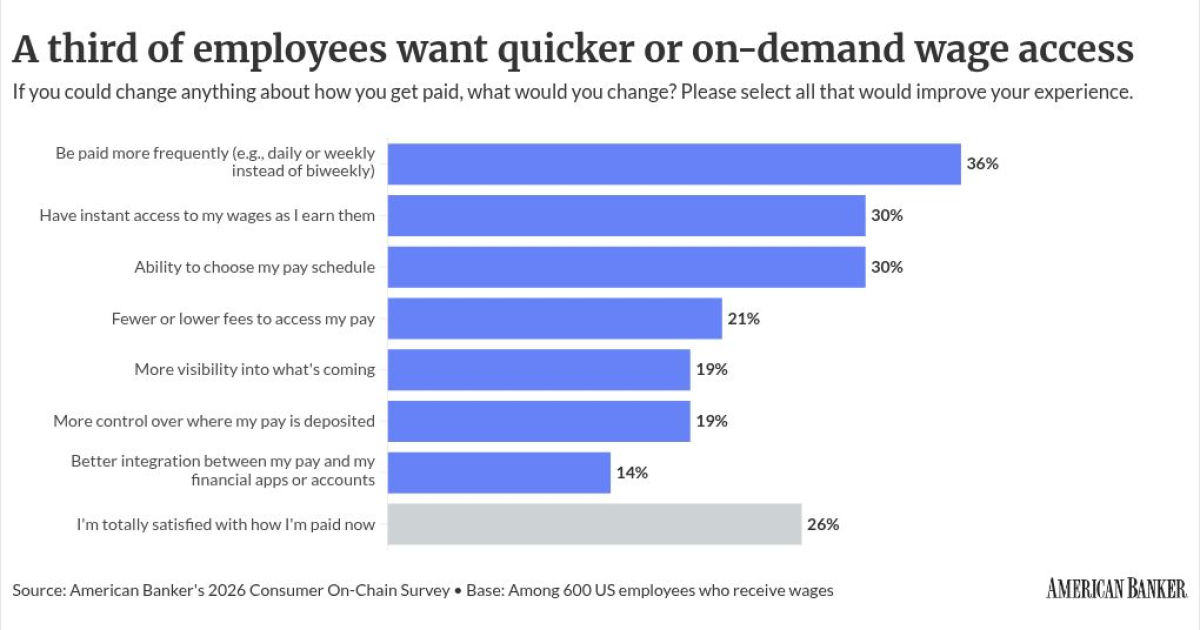
The lawsuit comes as consumer demand for faster pay grows. About one-third of respondents in American Banker’s 2026 On-Chain Consumer survey expressed interest in on-demand wage access.
According to the Colorado AG’s office, EarnIn made nearly 3.2 million advances totaling about $300 million to Colorado consumers between January 2023 and July 2025, collecting $16.1 million in tips and fees during that period. The lawsuit targets only EarnIn’s direct-to-consumer product, not employer-integrated offerings.