

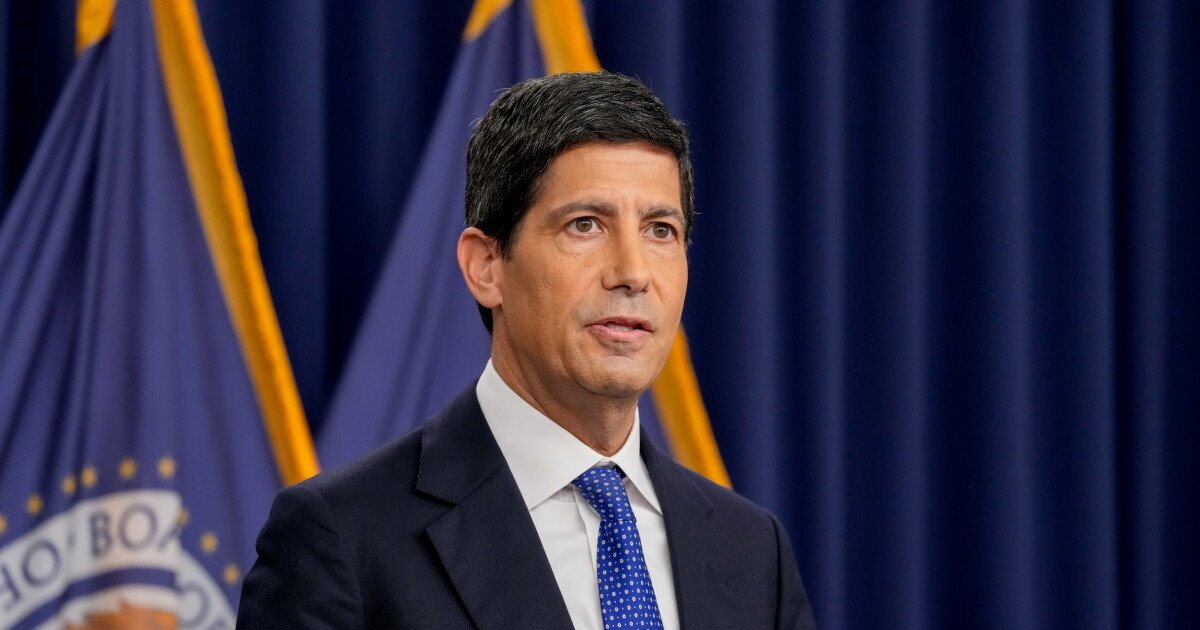
Federal Reserve Chair Kevin Warsh offered a distinct interpretation of the recent rise in U.S. Treasury yields during his post-Federal Open Market Committee press conference on Wednesday. While many analysts have pointed to ballooning government debt, inflation concerns, or the oil shock from the war in Iran, Warsh attributed the yield increase to a booming U.S. economy.
Yields rise when bond prices fall, typically due to lower demand. As values decline, bonds must offer higher yields to attract buyers. Warsh outlined three reasons for the run-up in yields.
Warsh’s Three Drivers of Rising Yields
First, Warsh cited economic strength. “Part of the reason why we’ve seen over the course of 2026 long-term yields go up is the economy is strengthened,” he said.
Second, he pointed to competition for capital. “The surge in capital expenditures … is real, and the so-called hyperscalers are out in the market raising funding, and so the competition for capital is real.”
Third, Warsh mentioned geopolitics, though not specifically the U.S. war with Iran. The FOMC removed the phrase “conflict in the Middle East” from its official policy statement on Wednesday. Instead, the chair referenced “hotspots around the world” as a driver of yields, “not simply spot prices of energy.”
Warsh acknowledged that many factors influence the demand for government debt and therefore its price and yield. His assessment of the bond market aligns with his broader view that the FOMC’s decision to raise interest rates was driven by positive economic developments despite global headwinds.
“Consider the geopolitical landscape of shocks and uncertainty, and you begin to appreciate the resilience of the U.S. economy,” he said. “Given that resilience and the potential for even greater performance, an attitude of optimism is exactly what I heard inside the FOMC these last two days.”
The Fed’s Independence from Market Signals
Heading into this week’s monetary policy meeting, many financial market analysts and observers wondered how responsive the Warsh-led committee would be to bond markets, which appeared to favor a rate increase. Warsh, who has advocated allowing financial markets to reach their own conclusions with minimal direction from the Fed, said he pays close attention to Treasury markets, particularly 10-year notes, which he called “the most important asset anywhere in the world.”
But he pushed back against the idea that the FOMC was simply doing the market’s bidding. “We made this decision today based on our assessment of the situation, based on our assessment of the trajectory for employment, based on our judgment on the strength of the economy,” he said. “Sometimes the market tries to prejudge our outcomes. I’ll observe market prices and see what they have to say. But today was our decision.”
Warsh acknowledged that while the committee could have raised rates in July, it opted to “buy time” by holding, in hopes that price growth would decline without intervention.
“A good majority of my colleagues seven weeks ago thought seven weeks is a good investment as a way to buy time so we can make a wise decision,” he said. Warsh said the decision to hike came from the series of inflation readings from the summer months, which collectively showed that inflation was not abating on its own and monetary policy was not doing enough to restrain excess demand.
“This view was widely shared by the committee,” he said. “So, we removed a dose of accommodation.”
No Neutral Rate, No Forward Guidance
Warsh said he does not have an ideal amount of financial accommodation that guides his policies, nor does he subscribe to the idea of a “neutral rate” — a point at which policy is neither accommodative nor restrictive — as a practical objective.
“I’ve always been interested in a neutral rate as an academic matter … it’s useful academically, as a discussion to help us think about policy,” he said. “Do I think it has any operational effect on decisions that we make today? No, I don’t.”
During Wednesday’s meeting, most FOMC participants wrote down their quarterly forecasts for the economy. All but two of the 18 members (not including Warsh, who again did not offer his projections) called for at least one more 25 basis point rate bump this year, while four said there should be two.
Warsh declined to say whether he saw Wednesday’s hike as the first of a series of increases or a one-off adjustment.
“I’m not in the forward guidance business,” Warsh said. “The decision we made today was a sober decision, serious decision, responsible decision — one that we have been preparing for and thinking about in my 110 or 120 days here.”
Warsh also turned down multiple opportunities to say whether or not he had spoken to President Donald Trump — who appointed him to the Fed chairman position with the expectation that rates would be brought down — about Wednesday’s decision.
“I don’t have anything for you on discussions with the president,” he said.