

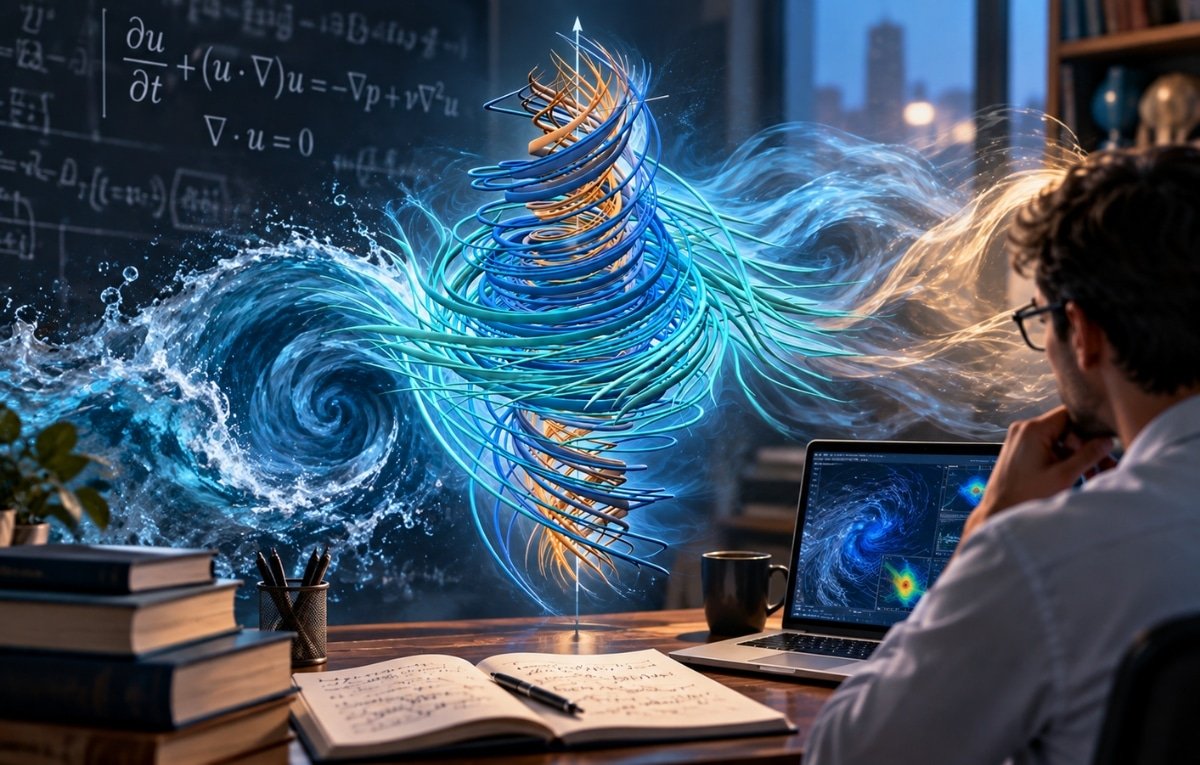
OpenAI has announced what it calls a “historic achievement” in mathematics: a purported solution to the Navier-Stokes equations, one of the most famous unsolved problems in the field for nearly a century. However, the announcement has quickly ignited controversy among researchers who question the circumstances and timing of the alleged breakthrough.
What Are the Navier-Stokes Equations?
The Navier-Stokes equations describe the motion of fluids and gases, such as water, air, and blood. They are central to physics and engineering, but they also pose a profound mathematical question: can we prove that these equations always provide a smooth and consistent description of fluid motion, or can they break down into chaotic behavior where no mathematical solution exists?
This problem is one of the seven Millennium Prize Problems selected by the Clay Mathematics Institute, each carrying a $1 million reward for a verified solution.
OpenAI’s Claimed Breakthrough
In a blog post, OpenAI stated that it solved the equations using an internal AI model that is “significantly more capable” than its recently released GPT-6 Astra. The company said it ran 10,000 AI agents in parallel to achieve the result. Training for the model began on August 28, and OpenAI claims it showed “unprecedented performance” on benchmark tests, including mathematics.
The company shared its announcement on social media, stating: “We’re sharing a solution to the Navier-Stokes Millennium Prize Problem, one of the deepest problems at the frontier of mathematics. The proof was produced by a group of agents, using an OpenAI next-generation model significantly more capable than GPT-6 Astra.”
Researchers Raise Questions
Given the significance of the claim, the announcement quickly drew scrutiny. Tristan Buckmaster, a mathematician at New York University, revealed that he had posted research findings related to the equations just one day before OpenAI’s announcement, in collaboration with Levent Alpoge, a researcher at Anthropic.
Buckmaster said he contacted OpenAI after learning that the company was aware of his and Alpoge’s progress. He alleges that OpenAI’s proof of the Navier-Stokes equations follows a research path he and Alpoge had been pursuing, using tools like OpenAI’s Codex and Anthropic’s Claude. This raised concerns that OpenAI may have accessed data or sessions from Codex that the researchers used during their project.
Buckmaster stated that he asked OpenAI directly whether the model had been trained on or had access to their Codex sessions. He claims he received a response saying the model did not access user data, but he did not get a clear answer when he asked again about training.
OpenAI Denies Using User Data
OpenAI has denied using “any specific user data to solve these equations.” However, the company added that it cannot rule out the possibility that anonymized data from product usage may have contributed to improving its models.
Sebastian Bobek, a member of OpenAI’s technical staff, also denied that the company had seen Buckmaster and Alpoge’s work before it was publicly posted. He asserted that OpenAI’s proof differs significantly from the researchers’ work, including in the mathematical results proven.
Buckmaster, however, responded that OpenAI’s statements indirectly imply that training data from a period after the researchers’ discovery may have been used in the model’s development.
A New Test for AI in Mathematics
This controversy comes at a time when advanced AI models are increasingly being touted as potential game-changers in mathematical research. These models are beginning to tackle problems that require complex reasoning, rather than just performing calculations or reproducing known information.
Yet, OpenAI has not yet released the details of its proof for independent verification by the mathematical community. Such verification is crucial before the Navier-Stokes problem can be officially considered solved under the standards of the Millennium Prize.
OpenAI has stated that it does not intend to claim the $1 million prize associated with the problem, despite describing the achievement as a significant breakthrough in mathematics.