

Most financial advisors believe they are excellent listeners. But a recent analysis of nearly 12,000 advisor-client meetings suggests otherwise. The data, collected by Jump’s AI notetaker between October 2024 and November 2025, shows that advisors spoke more than their clients in 84% of meetings. This finding, detailed in Jump’s 2026 Financial Advisor Insights Report, highlights a common gap between perception and practice.
The Listening Gap in Financial Advice
Edward Mahaffy, founder of ClientFirst Wealth in Little Rock, Arkansas, knows the challenge well. He works almost exclusively with pre-retirees and emphasizes the importance of letting clients speak first, especially in quarterly reviews. “They walk in for a quarterly meeting, and you’ve got the agenda that’s just, you know, we’re going to do tax planning this quarter, or we’re going to do income planning,” Mahaffy explains. “And the advisors have got in their mind a predetermined way that the meeting’s going to roll. But the clients may need to talk. Sometimes meetings take longer than you thought they would, and they’re very productive when you just hush.”
Advisors often see themselves as problem-solvers, eager to dive into financial complexities. However, this eagerness can overshadow the client’s voice. Mahaffy notes that while some clients appreciate detailed charts and statistics, most simply want reassurance that their retirement is on track. “Most people just want to get back to the golf course or go play with their grandkids and hear that they’re not going to run out of money,” he says.
Practical Strategies to Improve Listening
Start with Open-Ended Questions
Mike McMeans, president of Silverling Financial in Columbus, Ohio, begins every client meeting by saying he has a few items to discuss, but first, “I’d really like to hear why you think we’re here today and what you want to make sure happens.” This approach invites clients to set the agenda and express their true concerns. McMeans also reminds himself that clients rarely talk about money at home, so they may need extra time to articulate their thoughts. “People need a little bit more time usually to get their thoughts out because, nine times out of ten, these aren’t conversations they have at home,” he says.
Use AI to Track Your Speaking Time
Some advisors are turning to AI tools to measure their own behavior. Corinna Rose, a paraplanner at Bell Investment Advisors in Benicia, California, uses the AI notetaker Zocks to monitor her meetings. She aims for clients to speak at least 30% of the time. “If they’re doing all the listening, I may be delivering information, but I’m probably missing what’s most important to them,” Rose explains.
Melissa Caro, founder of My Retirement Network in New York, coaches advisors on using such metrics. She cautions against rigid rules, however. “The goal isn’t to hit the ‘right’ percentage,” Caro says. “It’s to understand why you’re talking, why you’re listening, and what the client needs from you at that particular moment. Metrics can point you toward a behavior worth examining, but developing the judgment behind that behavior is what ultimately makes someone a better advisor.”
Let Clients Lead on Current Events
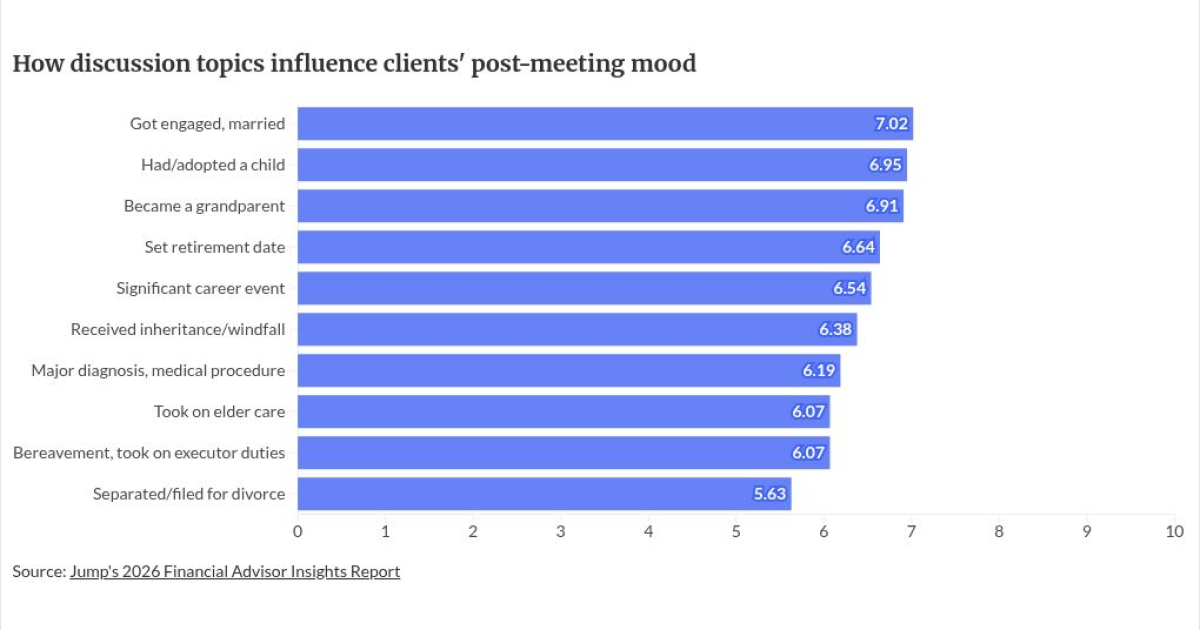
Jump’s research also examined client sentiment, using a scale from 1 to 10 based on language analysis. Clients began meetings with an average sentiment score of 6.44, but those expressing anxiety about paying bills scored lower at 5.32. Notably, clients’ sentiment improved when they initiated discussions about world events like tariffs, interest rates, or employment. When advisors brought up these topics first, sentiment scores often declined.
Financial commentator Rick Lake, who analyzed Jump’s findings, suggests advisors lead with open-ended questions like, “What has changed since we last spoke?” rather than steering the conversation toward recent news. Lake notes that clients typically raise such topics either out of genuine interest or because they relate to personal concerns. For example, questions about taxes might stem from fears about retirement security. “Advisors who do most of the talking have fewer opportunities to find out which client question they are actually answering,” Lake wrote.
Striking the Right Balance
While listening is crucial, there are times when advisors should take the lead. McMeans plans his meetings with a rough timeline, ensuring he covers necessary topics. He often paraphrases what he hears to confirm understanding: “I think I understand what you’re asking,” he says, then repeats it back to the client, aiming for an “exactly” in response.
The key is not to dominate but to create a dialogue where clients feel heard and understood. By asking open-ended questions, using AI to track speaking patterns, and letting clients guide discussions on sensitive topics, advisors can build stronger relationships and deliver more personalized advice. As Mahaffy puts it, sometimes the most productive thing an advisor can do is simply “hush” and listen.