

Registered investment advisors are not slowing their hiring plans because of artificial intelligence, but the technology is influencing which roles they prioritize. According to research released this week by industry consultant Cerulli Associates in partnership with tech investment firm Vista Equity Partners, RIAs are far more willing to add senior and junior advisors and client-facing associates than administrators, marketers, and compliance specialists.
The findings, drawn from a survey of 68 firms, align with widespread predictions that AI will primarily automate back-office functions rather than the client-facing work performed by advisors and their associates.
Hiring Plans Focus on Client-Facing Roles
Among the RIAs surveyed between May and June, 73% said they plan to hire junior advisors in the next two years, 67% plan to hire client associates, and 56% plan to hire senior advisors. By contrast, only 23% intend to hire administrators, 18% marketers, and 15% compliance specialists.
“What we’ve been hearing from the RIA space is that a lot of the administrative back-office roles are kind of on pause right now,” said Asher Cheses, senior director of wealth management at Cerulli Associates. “And before firms explicitly hire, they’re trying to really figure out where they can utilize AI to automate those functions and those tasks.”
AI Maturity Remains Low Across the Industry
Despite the hiring trends, the same survey indicates that many RIAs are still in the early stages of AI adoption. Cerulli and Vista Equity Partners developed an “AI Maturity Score” that ranks firms from 0 (least mature) to 100 (most mature) based on their answers to questions about governance and readiness, operational efficiency, and innovation and revenue.
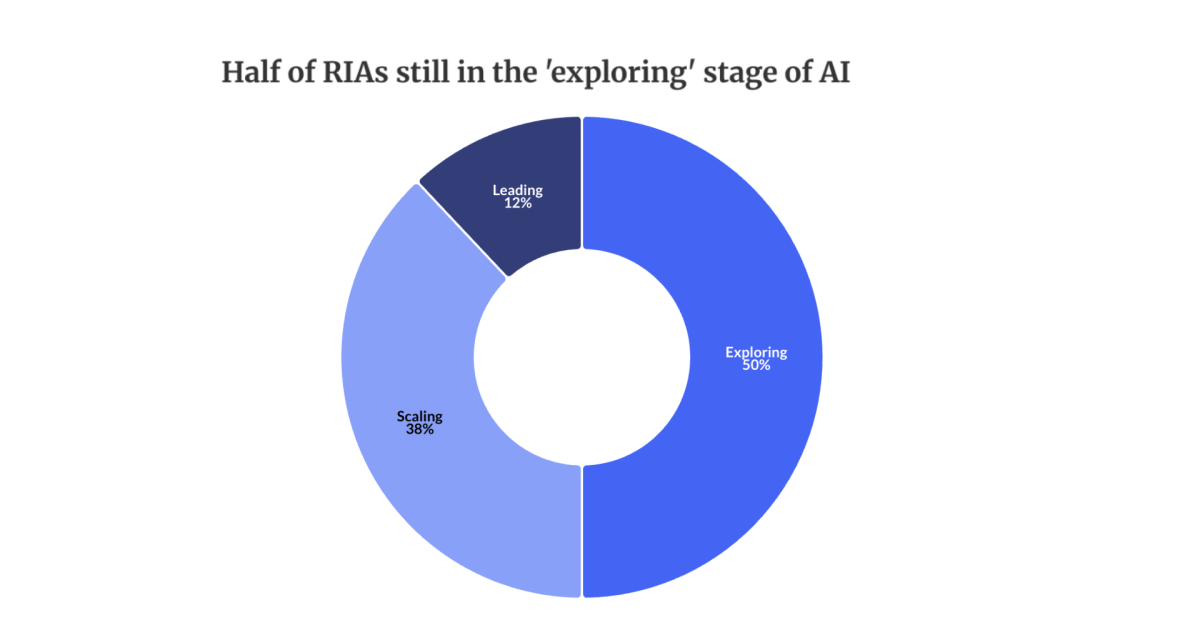
Half of the respondents were classified as being in the “exploring stage,” meaning they use AI but not in a managed way. Many lack written policies on acceptable uses of the technology, training in AI, and data formatted for AI. At this stage, employees tend to experiment individually rather than adopting AI firm-wide.
Another 38% were deemed to be at the “scaling” stage. These firms generally use AI for client communications, meeting preparation, and note-taking during client meetings, and they have AI use policies established or underway. Only 12% were considered “leading,” meaning they use AI in various ways across all advisory and back-office work. The average firm score on the maturity index was 32.
Cheses said that before the survey, he and his colleagues hypothesized that larger firms with big technology budgets and staffs would be the most eager adopters.
“What we actually found is that size and scale has little correlation to AI adoption, and the firms that have really been ahead of the curve tend to be smaller and more nimble, but have a very defined governance structure in place, and they have a defined owner [of AI projects],” Cheses said. He speculated that small RIAs tend to be newcomers with fewer legacy tech systems that must be modified or rebuilt to work with AI. Cheses added that one reason AI is easy for startups to adopt is that it is usually designed to respond to “natural language” prompts requiring no special technical knowledge or training.
Common AI Tools and Budget Trends
Many of the AI large language models most often used by advisors are the same systems widely available to the general public, according to Vista Equity Partners. They include Anthropic’s Claude, OpenAI’s ChatGPT, and Google’s Gemini, along with notetakers and assistants specifically built for advisors by firms like Zocks and Jump. Cerulli projected the percentage of firms’ technology budgets set aside for AI would rise from 8% to 15% by the end of this year.
According to Cerulli’s research, some of the most common benefits advisors reap from AI use are a reduction in time spent on administrative and manual tasks (cited by 64% of respondents), improved client communications (46%), and expedited investment research (33%).
Firms cited various factors contributing to their successes with AI. When asked, “Which approach has been the most effective at driving internal AI adoption at your firm?” 41% cited the presence of an “AI champion” responsible for finding ways to use the technology. That was followed by “grassroots adoption” (38%) and “training programs” (32%).
AI as a Growth Engine, Not Just a Cost-Cutting Tool
One way to reinvest money saved with AI efficiencies is to hire more advisors or train those already on staff.
“Firms getting this right aren’t treating AI as a cost-cutting tool,” said Dan Parant, the global head of private wealth solutions at Vista Equity Partners. “They’re treating it as a growth engine.”
Cheses said one of the biggest barriers to AI adoption is simple inertia: Some firms see no reason to change what has worked well for years. Additionally, some firms worry that regulators will scrutinize certain AI uses or that clients’ personal information could be exposed through an AI-related data breach.
Even so, Cheses predicted that continued pressure from advisor retirements will drive more firms to adopt AI. Even if the technology isn’t slowing hiring plans today, it can lighten workloads for existing advisors should replacing retirees prove difficult.
“I think it’ll likely relieve some of the capacity pressure,” Cheses said. “But, you know, I think firms that are bringing in younger advisors can utilize AI to help them service more households, and then over time, maybe take over their retiring advisors’ book of business, and maybe they can utilize AI to make it a more seamless transition.”